
When people talk about immigrating to the United States, you often hear terms like political asylum and the Cuban Adjustment Act. Both are ways people can legally live in the country, and they’re handled mostly by U.S. Citizenship and Immigration Services (USCIS). While they both offer a path to staying in the U.S., they’re quite different. Understanding the diferencia entre asilo politico y ley de ajuste cubano is pretty important if you’re looking into these options.
Key Takeaways
- Political asylum is for people fleeing persecution based on race, religion, nationality, social group, or political opinion. The Cuban Adjustment Act is specifically for Cuban citizens.
- Asylum can be applied for from within the U.S. or at a port of entry, and there’s no minimum time you need to have been in the country. The Cuban Adjustment Act requires you to have been inspected and admitted or paroled into the U.S.
- To qualify for asylum, you must meet the definition of a refugee and not be barred from applying. For the Cuban Adjustment Act, you need to be Cuban, have entered the U.S. after January 1, 1959, and have been physically present for at least one year.
- The main goal of asylum is to gain refugee status, which can lead to permanent residency later. The Cuban Adjustment Act’s direct aim is to provide a path to permanent residency (a green card).
- Asylum is based on international refugee law, while the Cuban Adjustment Act is a U.S. domestic law. USCIS handles applications for both, but the rules and requirements are distinct.
Understanding the Core Differences
When people talk about coming to the U.S. from Cuba, they often mention two main ways: political asylum and the Cuban Adjustment Act. While both can lead to a new life here, they’re actually quite different, with separate rules and goals. It’s easy to get them mixed up, but knowing the distinctions is super important if you’re considering either path.
Defining Political Asylum
Political asylum is a protection granted to people who have fled their home country because they fear persecution. This fear has to be based on specific reasons: their race, religion, nationality, membership in a particular social group, or political opinion. It’s a way for the U.S. to offer safety to individuals who can’t go back home without facing serious harm. The goal here is to grant refugee status, which is a temporary protection that can eventually lead to permanent residency. It’s rooted in international agreements and U.S. law, aiming to protect those who are genuinely at risk.
Defining the Cuban Adjustment Act
The Cuban Adjustment Act (CAA), on the other hand, is a specific U.S. law that applies only to Cuban nationals. It provides a direct pathway for Cubans who have been physically present in the U.S. for at least one year to apply for lawful permanent residency, often called a green card. This law doesn’t require proving persecution; instead, it focuses on nationality and physical presence. It’s a unique piece of legislation that has been around for decades, offering a distinct route for Cubans compared to other nationalities seeking to immigrate. You can find more details about the Cuban Adjustment Act on the official U.S. Citizenship and Immigration Services website.
Key Distinctions in Eligibility and Purpose
The main differences boil down to who qualifies and what the ultimate outcome is. Asylum is for anyone, regardless of nationality, who can prove a well-founded fear of persecution. The Cuban Adjustment Act is exclusively for Cubans. Furthermore, asylum’s initial goal is refugee status, while the CAA’s goal is straightforward permanent residency.
Here’s a quick rundown:
- Asylum: Requires proof of persecution based on specific grounds (race, religion, etc.). The initial status is refugee, with a path to permanent residency later.
- Cuban Adjustment Act: Requires Cuban nationality and physical presence in the U.S. for at least one year. The direct goal is permanent residency.
It’s important to remember that these are two separate legal processes. While both offer a way to live legally in the United States, they operate under different laws and have different requirements. Understanding these differences is the first step in figuring out which, if either, might be the right fit for someone’s situation.
Ultimately, asylum grants refugee status, while the Cuban Adjustment Act aims to provide permanent residency. This fundamental difference in purpose shapes everything from the application process to the long-term implications for an individual’s immigration journey.
Eligibility Criteria: Who Qualifies?
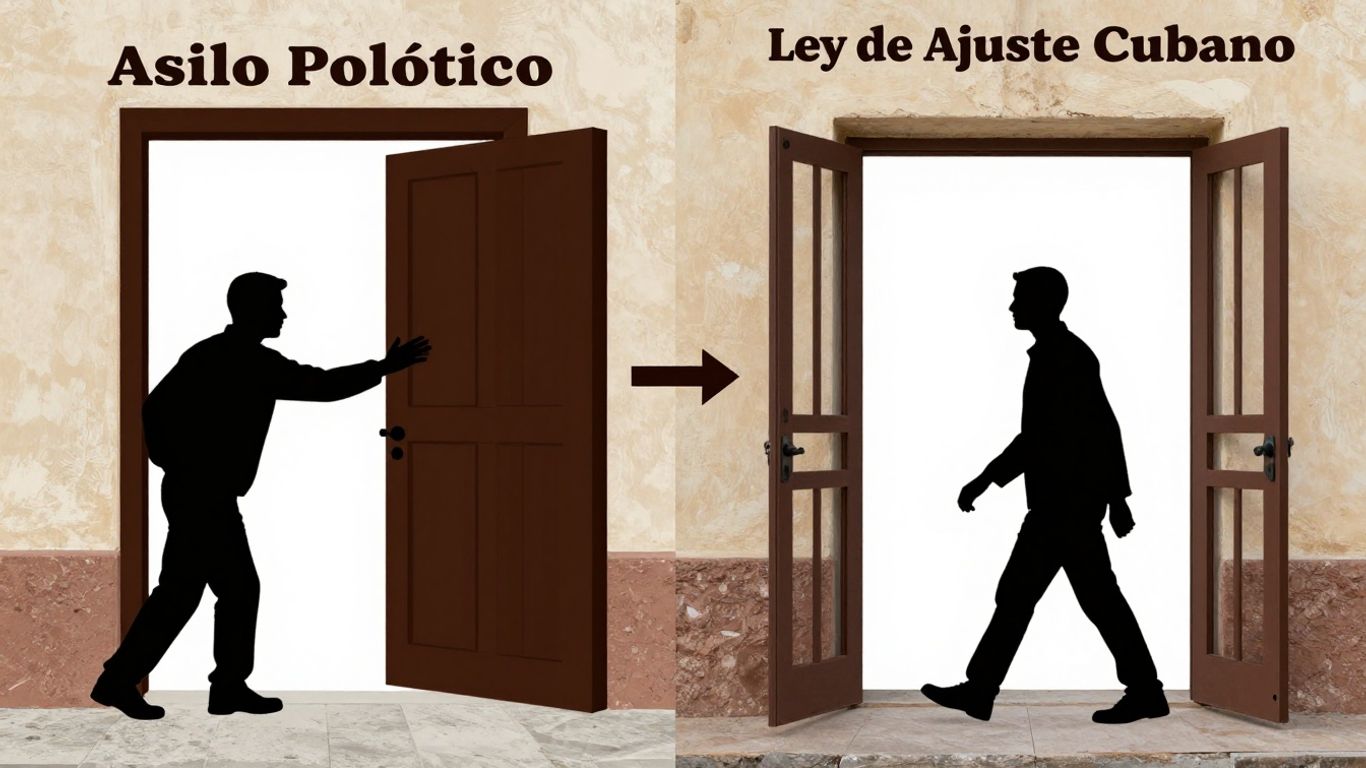
So, who actually gets to use these different pathways to come to the U.S.? It’s not a one-size-fits-all situation, and the requirements can be pretty specific.
Grounds for Political Asylum
Political asylum is for folks who have faced serious trouble back home. We’re talking about people who have been persecuted, or have a really good reason to fear they will be persecuted, because of:
- Their race
- Their religion
- Their nationality
- Their membership in a particular social group (this can be tricky and often involves things like gender or sexual orientation)
- Their political opinions
The key here is proving that the government in your home country either can’t or won’t protect you from this persecution. It’s a high bar to clear, and you’ll need solid evidence to back up your claims. You can apply for asylum whether you entered the U.S. legally or not.
It’s important to understand that asylum is a protection granted to those who meet the definition of a refugee and are physically present in the United States or at a port of entry. It’s not a pathway for general immigration but a specific form of protection.
Cuban Nationality Requirement for Adjustment Act
This one is much more straightforward, but also much narrower. The Cuban Adjustment Act (CAA) is specifically for people who are Cuban nationals or citizens. If you’re not Cuban, this pathway isn’t for you, plain and simple. It’s a special law created just for Cubans, and it has its own set of rules. You can find more details about the Cuban Adjustment Act and its requirements.
Specific Entry Requirements for Each Pathway
This is where things really diverge. For political asylum, you don’t necessarily need to have entered the U.S. through official channels. You can apply even if you’re already in the country without proper documentation, or if you arrived at a port of entry seeking protection. The focus is on your fear of persecution.
On the other hand, the Cuban Adjustment Act has a very specific entry requirement. You must have been inspected and admitted, or paroled, into the United States. This means you generally need to have had some kind of official interaction with U.S. immigration officials upon arrival. It’s not enough to just show up; you need to have been processed in a particular way. This is a big difference from asylum, where the entry method isn’t the primary concern. You also need to have been physically present in the U.S. for at least one year before applying for residency under the CAA. For those seeking to understand broader immigration benefits, understanding federal public benefits eligibility can also be important, though distinct from these specific pathways.
Navigating the Application Process
So, you’re looking into applying for either political asylum or using the Cuban Adjustment Act. It’s not exactly a walk in the park, and the paperwork can feel a bit overwhelming. Let’s break down what you generally need to get the ball rolling for each.
Required Forms and Documentation
Both pathways involve specific forms that need to be filled out accurately. For political asylum, the main form is the I-589, Application for Asylum and Withholding of Removal. This form asks for a lot of detail about why you fear returning to your home country. You’ll need to explain your situation thoroughly, and it’s often a good idea to include supporting documents like police reports, news articles, or affidavits that back up your claims.
For those applying under the Cuban Adjustment Act, the primary form is the I-485, Application to Register Permanent Residence or Adjust Status. This form is used to apply for a green card. Along with the I-485, you’ll typically need proof of your Cuban nationality, evidence of your entry into the U.S. (like an I-94 arrival record), and potentially other documents depending on your specific circumstances. It’s important to have your documentation in order before you submit anything.
Timing of Application Submission
When you can submit your application makes a big difference. With political asylum, you can generally apply at any time after arriving in the U.S., though there’s a one-year deadline from your date of entry to file affirmatively. If you miss that window, you might only be able to apply defensively if you end up in removal proceedings.
On the other hand, the Cuban Adjustment Act has specific timing requirements related to your physical presence in the U.S. You need to have been physically present in the country for at least one year before you can file your I-485. This continuous presence is a key requirement, so keeping track of your time in the U.S. is important. You can find more details about eligibility requirements for Cuban citizens.
Physical Presence Requirements
This is where things can get a bit tricky and differ significantly. For asylum, while you can apply after arrival, maintaining a continuous physical presence isn’t a strict requirement for the initial application itself, though extended absences can sometimes affect your case. The focus is more on the fear of persecution.
However, for the Cuban Adjustment Act, that one year of continuous physical presence is a hard rule. You must be able to show you’ve been in the U.S. for at least 365 days before you file your application. This means any trips outside the U.S. during that year need to be accounted for. Meeting this physical presence requirement is non-negotiable for the CAA.
Applying for immigration benefits can be a complex process. It’s often wise to consult with an immigration attorney or accredited representative to make sure you’re filing the correct forms and meeting all the necessary criteria. Mistakes can lead to delays or even denial of your case.
Here’s a quick look at the main forms:
| Application Type | Primary Form | Purpose |
|---|---|---|
| Political Asylum | I-589 | Seeking protection from persecution |
| Cuban Adjustment Act | I-485 | Applying for lawful permanent residency (green card) |
Remember, USCIS handles both of these processes, but they have distinct rules and goals. Getting the application right the first time can save a lot of headaches down the road. If you’re a Cuban national looking to adjust your status, understanding the filing requirements for Form I-485 is a good starting point.
Outcomes and Long-Term Status

So, you’ve gone through the process, whether it was applying for asylum or using the Cuban Adjustment Act. What happens next? It’s not just about getting approved; it’s about what that approval means for your life in the United States.
Asylum’s Goal: Refugee Status
When you’re granted political asylum, the main idea is that you’ve proven you can’t go back home because you’d face persecution. The U.S. government recognizes you as a refugee, even though you’re already here. This status isn’t permanent right away, but it’s a big step. It means you can live and work in the U.S. legally. After a year, you can usually apply for a green card, which is lawful permanent residency. It’s a pathway to a more stable life, away from the dangers you fled.
Cuban Adjustment Act’s Goal: Permanent Residency
Now, if you came through the Cuban Adjustment Act, the end goal is a bit more direct: a green card. This law is specifically designed to give Cubans a way to become permanent residents. The key difference here is that the CAA directly leads to permanent residency, while asylum is a protection status that can later be converted into permanent residency. You still need to meet certain requirements, like being physically present in the U.S. for at least a year, but once approved, you’re a lawful permanent resident. This means you have many of the same rights as other green card holders, like the ability to work and live anywhere in the U.S. It’s a pretty straightforward path to establishing yourself here.
Implications for Future Immigration
Both paths have different implications for your future. With asylum, you’re essentially recognized as someone needing protection. This status can be a foundation for building a new life, and eventually, for becoming a U.S. citizen. The process involves demonstrating a well-founded fear of persecution, which is a serious matter. For those who qualify under the Cuban Adjustment Act, the immediate outcome is permanent residency. This opens up many doors, including the ability to eventually apply for citizenship after a certain period as a permanent resident. It’s important to understand that while both pathways offer a chance at a new life, they stem from different legal grounds and have distinct long-term trajectories. The requirements for physical presence in the United States are also a significant factor in determining eligibility for each.
Comparing Legal Frameworks
When we look at political asylum and the Cuban Adjustment Act, it’s clear they operate under different sets of rules and have distinct origins. It’s not just about who gets in, but also about the laws that govern their entry and stay.
International vs. Domestic Legislation
Political asylum is largely governed by international agreements and conventions, like the 1951 Refugee Convention and its 1967 Protocol. These set broad standards for how countries should treat individuals fleeing persecution. The idea is to offer protection to those who can’t find it in their home country. This international framework aims for a global standard of humanitarian protection.
On the other hand, the Cuban Adjustment Act (CAA) is a U.S. domestic law. It was created specifically for people from Cuba and gives them a unique pathway to residency. This means its rules are set by the U.S. Congress and can be changed by them, unlike international treaties which involve multiple countries.
The Role of USCIS in Both Processes
Regardless of the legal basis, the U.S. Citizenship and Immigration Services (USCIS) is the agency that handles applications for both asylum and adjustment of status under the CAA. They are the ones who review the paperwork, interview applicants, and make the final decisions. However, the criteria they use and the evidence they require differ significantly based on whether you’re applying for asylum or through the CAA.
- Asylum: Applicants must prove they have a well-founded fear of persecution based on race, religion, nationality, membership in a particular social group, or political opinion.
- Cuban Adjustment Act: The primary requirement is being a national of Cuba and meeting specific entry and physical presence rules. Proving fear of persecution isn’t the main focus, though it’s the underlying reason for the act’s existence.
Historical Context of the Cuban Adjustment Act
The Cuban Adjustment Act has a history tied to the Cold War and U.S.-Cuba relations. It was enacted in 1966, a time when many Cubans were leaving the island due to political changes. The law has been modified over the years, but its core purpose – providing a path to permanent residency for Cubans – has remained. It’s important to note that the Cuban Adjustment Act has specific residency requirements, mandating at least one year of continuous physical presence in the U.S. before eligibility for permanent residency can be established.
The legal landscape for immigration is always shifting. While international law provides a broad safety net, specific U.S. laws like the CAA create tailored pathways that reflect unique geopolitical circumstances and historical relationships between nations. Understanding these differences is key to knowing which path might be available to someone.
Wrapping It Up
So, we’ve looked at two different paths for folks coming to the US from Cuba: political asylum and the Cuban Adjustment Act. They sound similar, but they’re really not. Asylum is for anyone fearing persecution for specific reasons, no matter how they got here or how long they’ve been here. The Cuban Adjustment Act, though, is specifically for Cubans, and it has its own set of rules, like needing to be in the US for at least a year. It’s a lot to take in, for sure. Understanding these differences is super important if you or someone you know is trying to figure out their immigration status. It’s always a good idea to get advice from someone who really knows this stuff to make sure you’re on the right track.
Frequently Asked Questions
What is the main difference between political asylum and the Cuban Adjustment Act?
Political asylum is for anyone who fears being harmed in their home country because of their race, religion, nationality, or political beliefs. The Cuban Adjustment Act is specifically for Cuban citizens who are already in the U.S. and want to become permanent residents.
Do I need to be in the U.S. for a certain amount of time to apply for political asylum?
No, you can apply for political asylum as soon as you arrive in the U.S. if you meet the criteria. There’s no minimum time you need to have lived here before applying.
What is the main requirement for the Cuban Adjustment Act?
To qualify for the Cuban Adjustment Act, you must be a Cuban citizen or someone born in Cuba. You also need to have entered the U.S. legally (or been allowed in by the government) after January 1, 1959, and have lived here for at least one year.
What is the end goal for someone seeking political asylum?
The goal of seeking political asylum is to gain refugee status, which offers protection in the U.S. because it’s not safe to return to your home country.
What is the end goal for someone applying through the Cuban Adjustment Act?
The main goal of the Cuban Adjustment Act is to allow eligible Cubans to become lawful permanent residents, also known as getting a green card.
Can someone apply for both political asylum and the Cuban Adjustment Act at the same time?
While both processes offer a way to stay in the U.S., they have different rules and goals. It’s best to talk to an immigration expert to figure out which path is right for you or if you can pursue both.